Robots? In My Hotel? Three Ways AI is Stepping Up as Hospitality’s Next Great PMS Support Tool

Artificial intelligence is uniting departments and supporting hospitality from behind the scenes
By Warren Dehan
Where did all of these robots come from? While hospitality may seem like the last place you might expect to find Artificial Intelligence, this technology has significantly impacted how hoteliers do business. While most generative AI today reacts to text prompts, it will soon rewrite the rules for hotel operations. Properties of all sizes, branded and independent alike, will benefit from automation taking over repetitive, mundane tasks — but our industry often struggles to explain how this will play out in practice.
Unlike science-fiction novels, the most effective robots in hospitality will not be walking around, but they will be interacting directly with guests. Predictive analytics has become the ultimate prescription for an industry needing additional support, and the hotel property-management system is the gateway to deliver and manage all AI-generated data for improved guest communications.
Here are a few ways this technology will be of use to hoteliers:
Improved Guest Interactions
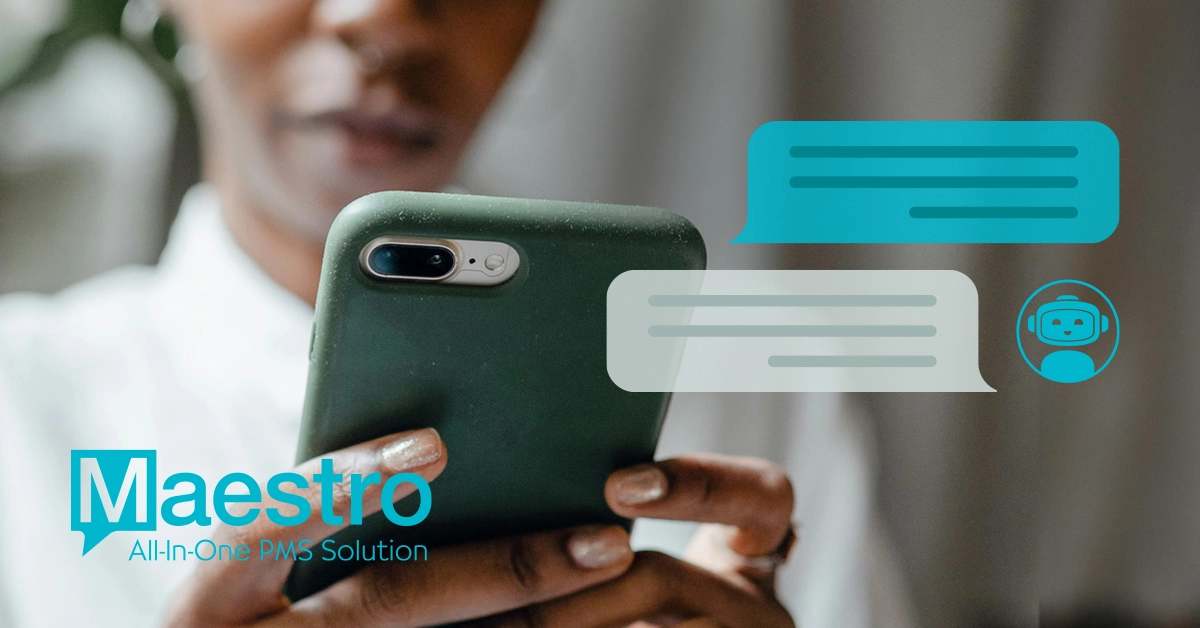
Travelers are engaging with hotels via text messages and digital interactions, with the PMS serving as the central hub for behavioral guest information. International travelers, for instance, can inquire about available amenities in their native tongue, but rather than having dedicated multi-lingual team members in place to address every low-level inquiry submitted to the hotel, they can filter most questions through their PMS interface to answered by a digital chatbot.
Today’s chatbots can already provide guests with a hotel’s Wi-Fi password, confirm opening hours for hotel services, and request reminders or wake-up calls. They use predictive analytics and past interactions to make educated decisions about responding to new conversations.
A recent study shows these requests account for guests’ most commonly asked questions, making them a frequent source of repetition among hotel workers.
While one might prefer live agents for business support, chatbots help answer commonly asked questions and address frequent traveler woes. In the near future, AI-powered chatbots will be able to recognize the tone and tenor of a conversation with guests and escalate it to operators when necessary. Hotels must ensure their PMS providers offer the essential features to support seamless switching between automated and manual responses, including the required alerts to inform operators of the context behind guest inquiries.
Using AI to capture these questions before they reach hotel operators can reduce short, transactional conversations with associates in favor of more lasting interactions. In today’s limited labor market, access to a simple chatbot could mean the difference in hotel associates falling behind during their shifts or having the time to interact with guests.
Connecting the Dots Across Departments
The impetus behind developing AI for the workforce was to improve pattern recognition within business intelligence tools and increase a business’ competitive standing. Hotels with a unified tech stack can use AI to gather data across multiple departments and support hotelier decision-making through forecasts, suggestions, and alerts. The hotel PMS can serve as a natural nexus for digital decision-making, the driver’s seat for on-property AI.
For AI to be effective in this manner, it must draw on vast stores of data sourced from all hotel departments. Many independent operators today have isolated departments, limiting the data and capabilities hotels can access. It’s not enough to present data between departments during meetings or discussions. Information must be accessible under one unified PMS designed to connect revenue management, room management, and operations systems to flourish, let alone leverage AI.
Independent hoteliers must find ways to foster cooperation among technology partners to help create this unified system, or our industry will be the last to innovate while their competitors grow in sophistication. Today’s most sought-after PMS technology providers are prioritizing such partnerships. This approach is separate from a hotel’s technology integration strategy, but the ethos is similar. As such, operators must find ways to coax partners into working together or find new partners. This technology is poised to bring innovation to hospitality and all other industries and is waiting for no one.
Preserving Hospitality’s Mission of Service
Since AI grows its capabilities alongside its stores of available data, it’s not difficult to imagine how prompts and chatbots could guide guests through the entirety of their journey in the near future. Diverting repetitive requests to AI presents a more significant impact than simply performing actions faster; it allows operators to rework their position from supervising technology to overseeing the guest experience. However, operators need faith before taking their hands off the wheel. This only works if hotels have access to all the necessary information to check and balance AI while it works, and it must be visible in one place.
When AI is filtered through the PMS, it supports hotels’ return to the core elements of hospitality, but only if owners and operators plan to accommodate it in advance. The hotel PMS is an ideal destination for the specific, granular insights gathered by AI and pattern recognition tools. Operators don’t have time to check multiple systems to ensure their automated tools work correctly. Instead, the PMS is emerging as the one system, dashboard, and control panel they can rely on to provide necessary incites to drive hotel operations.
The reason AI is so important to consider today is not that it will replace humans in our industry, but because of how essential human connection is to succeed. At a time when the rush for technological innovation has people afraid to lose human interaction, things like eye contact, a warm smile, and a cheerful “hello” at check in speaks volumes about the service that is to come. Therefore, it’s critical that the hotel PMS is intuitive enough to enable front desk staff to do these engaging tasks, rather than keeping their heads down and eyes glued to the computer screen. Personal service, trust, and old-fashioned “hospitality” still matter.
Don’t get buried in the daily minutia of hotel operations. Rather, consult with technology partners to integrate with other solutions, identify focus areas, and devise a plan to modernize your tech stack and build a unified data strategy. Adaptation will help hotels of all sizes offer every aspect of a digital guest journey and the benefits of task automation.
About the Author

Warren Dehan is the President of Maestro, the preferred Web Browser based cloud and on-premises all-in-one PMS solution for independent hotels, luxury resorts, conference centers, vacation rentals, and multi-property groups. Maestro’s enterprise system offers embedded payments and 20+ integrated modules on a single database, including mobile and contact free apps to increase profitability, drive direct bookings, centralize operations, and enable operators to engage guests with a personalized and safe experience. Maestro’s Support Service provides unparalleled 24/7 North American based live support and education services.