Stop Guessing: How Reality Capture Improves Construction Productivity

Construction projects lose time and money when teams rely on assumptions. Someone says a section is “done,” another trade arrives, and then problems appear: wrong levels, missing openings, clashing services, or unfinished areas. That leads to rework, delays, and arguments. Reality capture helps because it replaces opinions with clear evidence.
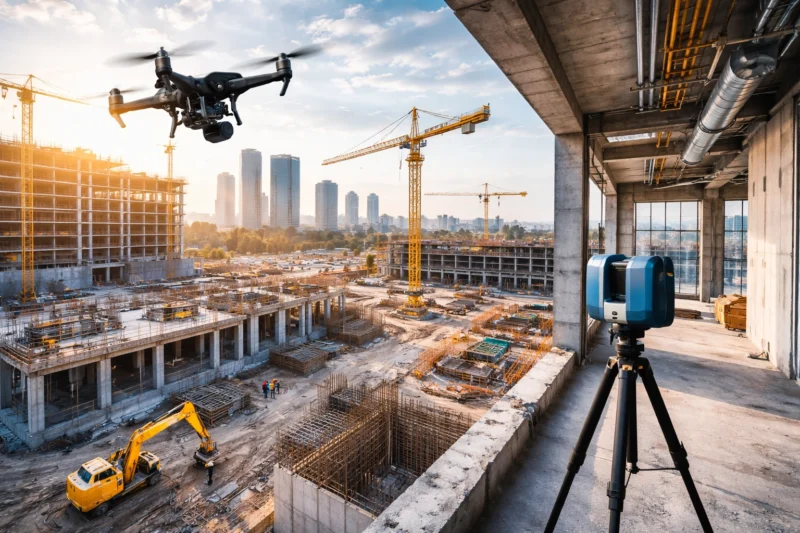
Reality capture means using tools like drones, laser scanning (LiDAR), and 360 cameras to record what is really happening on site. Drones are great for exteriors, roofs, and large areas. Laser scanners are best for accurate measurements inside buildings. 360 cameras are useful for quick walkthroughs that anyone can review from the office.
Why it matters
The biggest productivity killer in construction is rework. Rework happens when mistakes are found too late. The later you find a problem, the more expensive it is to fix. Reality capture helps you find issues earlier, when they are still easy to correct.
It also helps with coordination. Many site problems come from different trades working with different information. Reality capture creates a shared record that everyone can see, so teams don’t argue based on memory or incomplete photos.
How it helps in real projects
1) Progress tracking becomes clear
Progress reporting often becomes a debate. A subcontractor says 80% complete. The main contractor says 60%. The client wants proof. With reality capture, you can show what is installed and what is not. A drone flight can show earthworks, site layout, and external progress. A 360 walkthrough can show interior progress like partitions, cable trays, and ductwork. This makes progress reporting more objective and reduces payment disputes.
2) Quality checks become faster and more reliable
Quality problems usually start small. A wall is slightly out of line. A slab opening is off by a few centimeters. A bracket is not placed correctly. These issues might be missed until later, when the facade, ceiling, or MEP works cannot fit properly. Laser scanning can check measurements and alignment early. Drones can capture facade and roof installation progress. This reduces hidden defects that later become major repairs.
3) Fewer claims and easier dispute resolution
Many construction claims happen because people disagree about what happened and when. Photos are incomplete. Site diaries don’t match. Staff change and no one remembers details. If you capture the site regularly, you have a time stamped record of site conditions. That makes it easier to prove facts, resolve disputes faster, and avoid long arguments. It also discourages “creative stories,” because evidence exists.
4) Better site planning and safer operations
Reality capture helps teams plan site logistics. Drones show laydown areas, delivery paths, access routes, and crane zones. If the site becomes congested or unsafe, it’s visible. This supports safer planning and reduces wasted time caused by poor site layout.
What leaders should focus on
Don’t start by buying technology. Start with the problem you want to solve. Usually it’s one of these:
- Too much rework
- Poor coordination between trades
- Slow progress reporting and payment disputes
- Too many defects found late
- Claims and arguments that waste management time
Once you choose the main goal, build a simple routine.
A simple way to implement reality capture
Start small and keep it consistent.
Choose a capture schedule. Weekly is common during busy stages. Biweekly may be enough during slower stages.
Define what you will capture:
- Drone route for external progress (same angles each time)
- 360 walkthrough route for key areas (same path each time)
- Laser scanning for areas needing accuracy (MEP corridors, risers, plant rooms, facade interfaces)
Set clear outputs:
- A folder or platform with date based records
- Photos or walkthroughs labelled by level/zone
- A short issue list: what’s wrong, where it is, and who owns the fix
Assign one person to own the process. If no one owns it, it becomes random, and the value drops.
Common mistakes to avoid
Reality capture becomes useless when teams treat it as “nice content” instead of a control tool. Avoid:
- Collecting lots of data with no plan to use it
- Inconsistent routes or angles that make comparisons hard
- Files stored in random places with no naming system
- Capturing problems but not assigning action to fix them
The point is not to collect more data. The point is to make faster decisions and prevent rework.
The bottom line
Reality capture improves construction productivity because it gives teams visibility. It shows what is actually built, what is missing, and what is incorrect early enough to correct it cheaply. It reduces rework, prevents disputes, speeds up progress verification, and supports better planning. In construction, better visibility leads to better control, and better control leads to better profit.
Author